




















Chinese New Year is a time for food, family and festivities, and with 2026 ushering in the Year of the Fire Horse, saddle up for celebrations across the country.

What is Chinese New Year?
Otherwise known as the Spring Festival (春节), Chinese New Year (新年) marks the end of the winter season and the beginning of a 16-day festival where families gather to welcome a year of health, prosperity and good luck.
When is Chinese New Year?
Chinese New Year begins with the New Moon on 17th February 2026. The date on which the New Year is celebrated is based on the solar and lunar calendars rather than the Gregorian calendar, resulting in changes to the Chinese New Year date every year.
Chinese communities in the UK typically celebrate the New Year the weekend after New Year’s Day. Since Chinese New Year takes place on a Tuesday in 2026, most celebrations in the UK will be taking place on 21st February 2026.
How long is Chinese New Year celebrated for?
Chinese New Year is traditionally celebrated for sixteen days, although preparations for the festival can begin long before that.
Laba Festival
Some families start to prepare for the Chinese New Year as early as the 8th day of the 12th month of the lunar calendar, on a festival called Laba (腊八). Falling on 26th January 2026, this day is where families pray to ancestors and gods for good fortune and a successful harvest, and eat Laba porridge, Laba tofu and noodles.
Little Year
Preparation for the Chinese New Year can also begin slightly later, on 10th or 11th February 2026, on the Little Year (小年). At this time, people start to prepare food, clean their houses and pray to the stove god.
House cleaning
On the 24th day of the lunar month, or the 11th February 2026, an intensive ‘winter cleaning’ takes place.
People begin to sweep away the dust and get rid of dirt, rubbish and other unwanted items. This symbolises the removal of the bad and old from the previous year, while readying the house to welcome in the New Year.
Why is it the ‘Year of the Fire Horse’?
The Chinese Zodiac, or Sheng Xiao, consists of 12 animals, with each animal allocated a year in each cycle, starting with the Year of the Rat and ending with the Year of the Pig. At the beginning of 2026, the Chinese calendar was approaching the end of the Year of the Snake, with the Year of the Horse being next in the cycle.
Each year is also allocated one of five elements, cycling through wood, fire, earth, metal and water. Together, the element and animal allocations create a 60-year cycle, making this Year of the Fire Horse the first to come around since 1966.

Chinese New Year traditions and food
Chinese New Year is a time for family, with millions of people travelling across the country every year to return home in what’s known as Chun Yi (春运), or Moving in the Spring.
When together, the celebrations can begin, with traditional Chinese New Year foods and festivities enjoyed by every generation.
1. Chinese New Year decorations
As the Chinese New Year approaches, decorations start to appear in the home and on the streets to welcome the gods of wealth for a prosperous year ahead.
Paper-cut red lanterns, display couplets and the Chinese character for ‘luck’ (福) can be found inside and outside of houses, while banners, flags, flowerpots and orange trees appear in public spaces, creating a festive atmosphere and heralding good luck.
2. Chinese New Year’s Eve dinner
As the most important dinner of the entire year, the Chinese New Year’s Eve dinner, or Nian Ye Fan (年夜饭), is opulent.
In Northern China, people usually eat Jiaozi dumplings with meat, seafood and vegetables, whereas Tangyuan dumplings, a type of glutinous rice ball, are more popular in Southern China.
Fish dishes are common at a Chinese New Year’s Eve banquet, as the character for ‘Fish’ (鱼) reads the same as ‘Plenty’ (余), symbolising wealth in the year ahead.
In Beijing and Northern China, a dish called Laba Congee cooked with rice, beans, peanuts and dried fruit, is eaten to symbolise the harvest of the past year.
In Southern China, Nian Gao, a sticky, steamed cake made with rice and cane sugar, is eaten for good luck. This comes from Nian Gao sounding similar to ‘Year High’ in Chinese, representing a more promising year ahead.
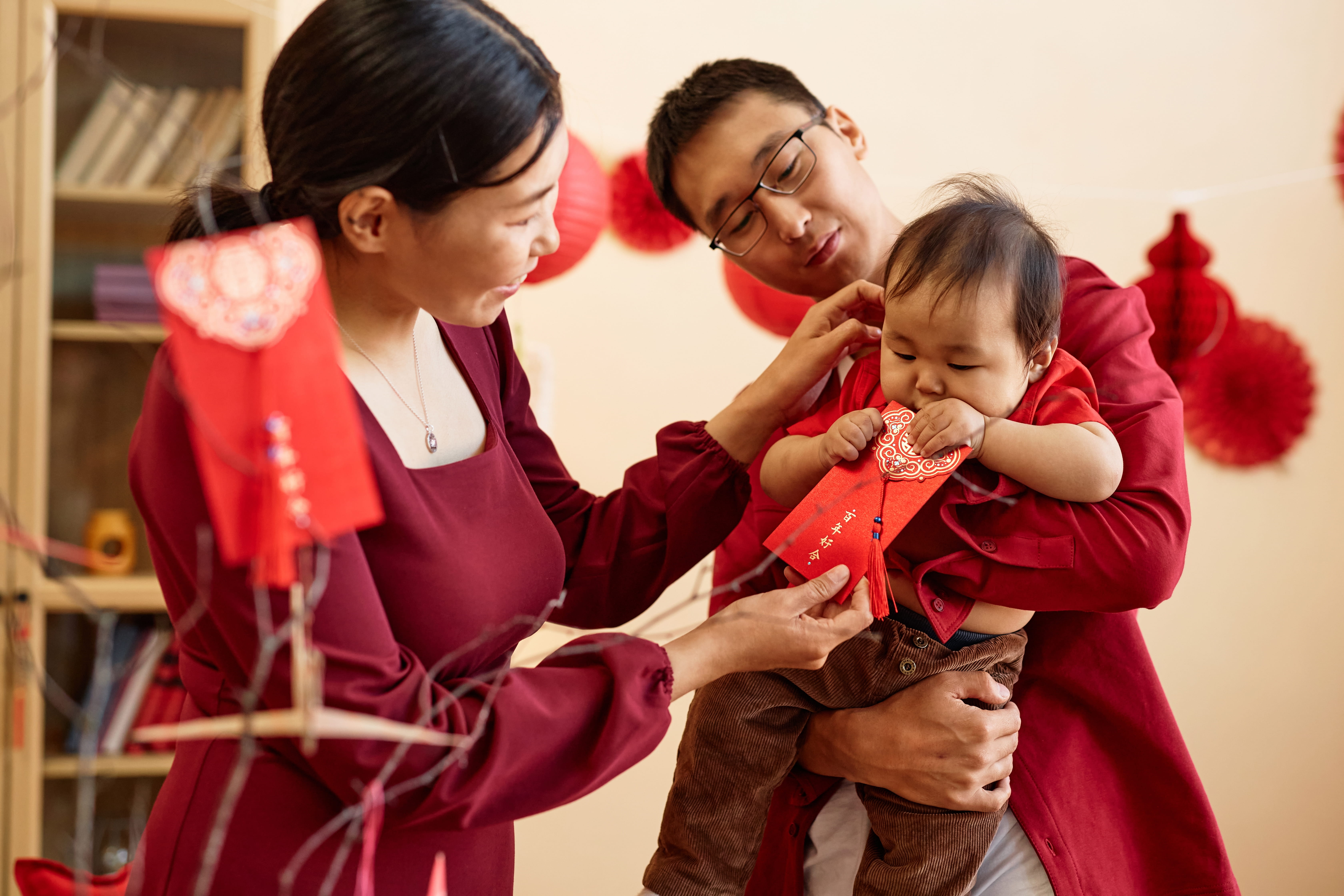
After the New Year’s Eve reunion dinner has finished, parents and older members of the family usually give children red envelopes with money inside. This tradition is believed to bring good luck and is usually given with wishes of health, growth and good studies in the year ahead.
3. Chinese New Year’s Eve traditions
Chinese New Year is all about spending time with family, although how families spend time together differs depending on the region.
Families in North China get together to make Jiaozi dumplings with peanuts, dates, chestnuts, meat and sometimes coins for luck. Southern Chinese families traditionally sit around the stove and watch the New Year Gala on television, eating and talking the night away.
On Chinese New Year’s Eve, families stay up late as part of a custom called shousui (守岁), meaning to ‘keep watch over the year’. In the past, people would light candles or oil lamps and stay up all night observing this custom.
Nowadays, many turn in for the night after firework displays welcoming in the New Year have ended.
4. Chinese New Year’s Day
It’s widely believed that how you spend Chinese New Year’s Day affects your luck for the rest of the year, so getting the year off on the right foot is of utmost importance.
To start the day, many wear new clothes and wish others good luck and happiness in the New Year. Younger family members will often visit their elders to wish them health and longevity for the year ahead.
The remainder of the day is dedicated to festivities, including watching live performances, Dragon Dances and Lion Dances, and attending New Year’s Day parades.
There are plenty of ways to celebrate Chinese New Year, no matter where you are in the UK. With Avanti West Coast, simply book your ticket and make your way to the city of your choice to celebrate.

Celebrating Chinese New Year in London
From Chinatown to Trafalgar Square, there are plenty of places to celebrate Chinese New Year in London.
Avanti West Coast trains make it easy to get to London Euston, while TfL connections quickly transport you the rest of the way so you can welcome the Year of the Horse from anywhere in the city.
Chinese New Year Lion Dance: Essential information
Traditionally, seeing one of the four Lucky Mascots (吉祥物) at Chinese New Year is said to bring good luck for the year ahead and drive away evil spirits, so start the Year of the Horse on a high note with one of these vibrant, traditional displays.
- Date: 21st February 2026
- Start time: 11 am
- Ticketing: Free
- Location: Chinatown
Lunar New Year celebration: Essential information
Immerse yourself in Chinese New Year celebrations at the National Maritime Museum in Greenwich. From traditional Lion Dances in the East Colonnades to puppet shows, Chinese music and martial arts demonstrations, there’s something for everyone at this full-day affair.
- Date: 21st February 2026
- Start time: 10 am
- Ticketing: Free
- Location: National Maritime Museum, Greenwich
Chinese New Year’s Day parade: Essential information
Come along to this colourful parade, where lions and dragons dance through the streets of London to the sound of Chinese pop hits, and a lineup of artists from China perform for the crowd.
Along the way, you can catch a glimpse of martial arts displays, peruse arts and crafts stalls and sample traditional Chinese cuisine from the food stalls dotted around the square.
- Date: 22nd February 2026
- Start time: 10 am
- Ticketing: Free
- Location: Trafalgar Square

Celebrating Chinese New Year in Manchester
Make your way to Manchester Piccadilly for a Chinese New Year’s celebration to remember.
Dragon Parade: Essential information
Arguably the highlight of Manchester’s Chinese New Year celebrations, the Dragon Parade has it all: dancers, drummers, acrobats and a giant dragon weaving through the city streets.
- Date: 15th February 2026
- Ticketing: Free
- Location: Manchester city centre
Manchester Lunar New Year Fair: Essential information
Spanning Market Street, Exchange Square and New Cathedral Street, Manchester’s Lunar New Year market boasts over 120 stalls celebrating Chinese and East Asian culture.
- Dates: 14th-15th February 2026
- Ticketing: Free
- Location: Market Street, Exchange Square and New Cathedral Street
Floating Art – Lunar New Year Art Workshops: Essential information
Want to learn something new while celebrating Chinese New Year? Local arts business ‘Floating Art’ is hosting beginner-friendly workshops rooted in Eastern art.
These workshops cover a range of topics from Chinese painting on rice paper lanterns to a brush painting workshop, focusing on Chinese brush painting techniques.
- Dates: 14th-22nd February 2026
- Ticketing: £32 to £34, depending on the workshop
- Location: House of Social, 10 Sir Howard Bernstein Approach, Manchester, M15 4ND

Other UK cities celebrating Chinese New Year
Want to celebrate Chinese New Year, but fancy a change of scene? Step outside the capital without compromising on flair with Avanti West Coast.
Chinese New Year in Birmingham
Co-produced by Birmingham Chinese Festival Committee and Birmingham Hippodrome, Birmingham’s Chinese New Year Festival is set to be spectacular, with traditional and modern music, dance and theatre performances from local talent.
- Date: 22nd February 2026
- Ticketing: Free
- Location: Birmingham Hippodrome Theatre, Hurst Street, Southside Birmingham, B5 4TB
Chinese New Year in Liverpool
Liverpool’s annual Chinese New Year celebrations are set to hit the city again in 2026, with activities, workshops and events themed around the Year of the Horse lined up for Liverpudlian festival-goers.
- Dates: 21st-22nd February 2026
- Ticketing: Free
- Start time: 11am
- Location: Liverpool city centre
Chinese New Year in Edinburgh
For a more low-key Chinese New Year, immerse yourself in Edinburgh’s creative scene with HelloArt’s Chinese Lunar New Year Market. Don’t miss the lantern riddles designed to spark curiosity and Fu character writing for luck and blessings.
- Dates: 21st February 2026
- Ticketing: Free
- Start time: 12pm
- Location: OOTB Drill Hall, 36 Dalmeny Street, Edinburgh, EH6 8RG

Helpful tips for Chinese New Year
The Year of the Fire Horse promises energy, action, and intensity, so get yours off to a flying start with our helpful tips:
- Book in advance: While you might get lucky and land a last-minute ticket, it’s best to have everything booked in advance.
To avoid missing out on the celebration of your choice, sort your travel, book your accommodation and buy your event tickets as early as possible. - Prepare for the weather: With Chinese New Year taking place in February, be sure to check the forecast beforehand and dress accordingly.
- Bring appropriate footwear: Most Chinese New Year festivals take place outside, with parades and markets spanning many streets, which means lots of walking.
To get the most out of the celebrations, opt for comfortable footwear that can withstand the stepcount.
Travelling for Chinese New Year by train with Avanti
Whatever your plans are for Chinese New Year, booking your tickets and travel is essential to securing the best events and train times for you.
Book in advance for the lowest prices and invest in a Railcard to save a third on ticket prices. If travelling with loved ones, you can save even more with our family fares.
By opting to travel by rail, you’ll also avoid car congestion and parking fees and instead enjoy stress-free, sustainable travel.